After the 18th century and well into the 19th century, the idea of romanticism spread quickly throughout Europe and the United States. This new idea challenged the old way of thinking brought on by the enlightenment. This new era brought artists forward that emphasized sense and emotions instead of reason and order like previous eras. These new “romantic” ideas brought a new way of looking at and understanding the world as people began to search for individual rights and liberty. These new voices reached far more than just art genres as it also affected literature, music, and architecture as well. Many times Romantic Era painters found themselves turning their attention to nature and “plein air” painting. (Painting out of doors) Many painters attempted to portray nature’s power and unpredictability trying to show the viewer both the awe and the terror in the painting.
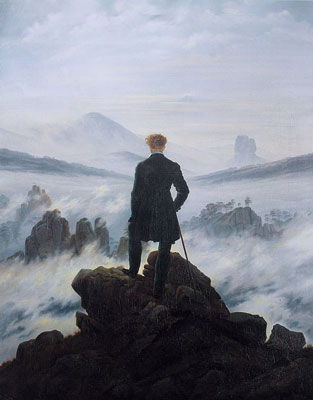
Wanderer Above the Sea of Fog (1818)
Caspar David Friedrich
This first painting that I chose is Wanderer Above the Sea of Fog as it really caught my eye with the look of the ocean. I enjoy the swirling fog, jagged rocks shown along the coast line and the hills in the background. Although this painting is very breathtaking, it is the making of an Imaginary scene. Friedrich made landscape sketches in the mountains of Saxony and Bohemia in preparation for this painting. This means that this painting was more than likely a composite collection of many of his sketches that he had made previously.
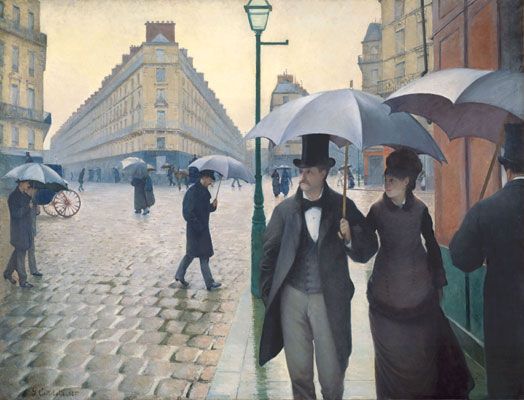
Vetheuil in the Fog (1879)
Claude Monet
I chose this painting as I enjoy the impression that Claude was attempting to capture. He waited to paint this piece until the sunlight was exactly right before quickly painting down all of the lines that he saw. This is one of his more popular pieces as it offers a subtle, distinct impression of the figure that he was trying to capture. Monet often times focused on fleeting changes in nature and preserved them in the picture planes by painting very fast before anything shifted.
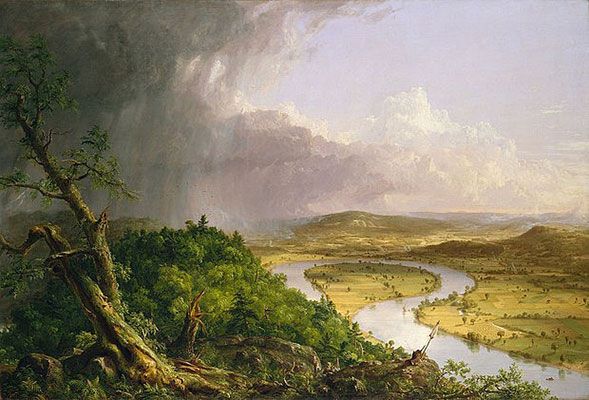
The Oxbow, View from Mount Holyoke, Northampton, Massachusetts after a Thunderstorm (1836)
Thomas Cole – Hudson River School of Painters
I enjoy this painting as it symbolizes American freedom which was a large contributor to the Romantic Era paintings. The Connecticut river in this picture after a rainstorm looks so free and winding and it is painted almost as if it had just been discovered. In this photo we can observe two different areas within the painting, on the left side a dark and cloudy storm blowing out of site with a green sunlit area to the right. If you look at the bottom right corner you can also see a figure of a human which the artist is depicting of himself. Thomas Cole was among the most important and influential member of the Hudson River School of Painters.

Kindred Spirits (1849)
Asher Durand – Hudson River School of Painters
I enjoy this painting as it shows two of Durand’s good friends, also from the Hudson River School in the woods with him, Thomas Cole, and poet William Cullen Bryant. The Hudson River School put a major emphasis on nature and the unending beauty of nature, and it shows when you look at works from both Durand and Cole. This painting was painted by Durand apon Cole’s death in 1848 for poet Bryant. The painting was donated to the New York Public Library by Bryant’s daughter in 1904 and sold at an auction in 2005 for a whopping 35 million dollars.
References:
“Romanticism Movement, Artists and Major Works.” The Art Story, http://www.theartstory.org/movement-romanticism.htm.
“Asher Brown Durand.” Wikipedia, Wikimedia Foundation, 3 Oct. 2018, en.wikipedia.org/wiki/Asher_Brown_Durand#Painting_career.

 SRS Alaska